

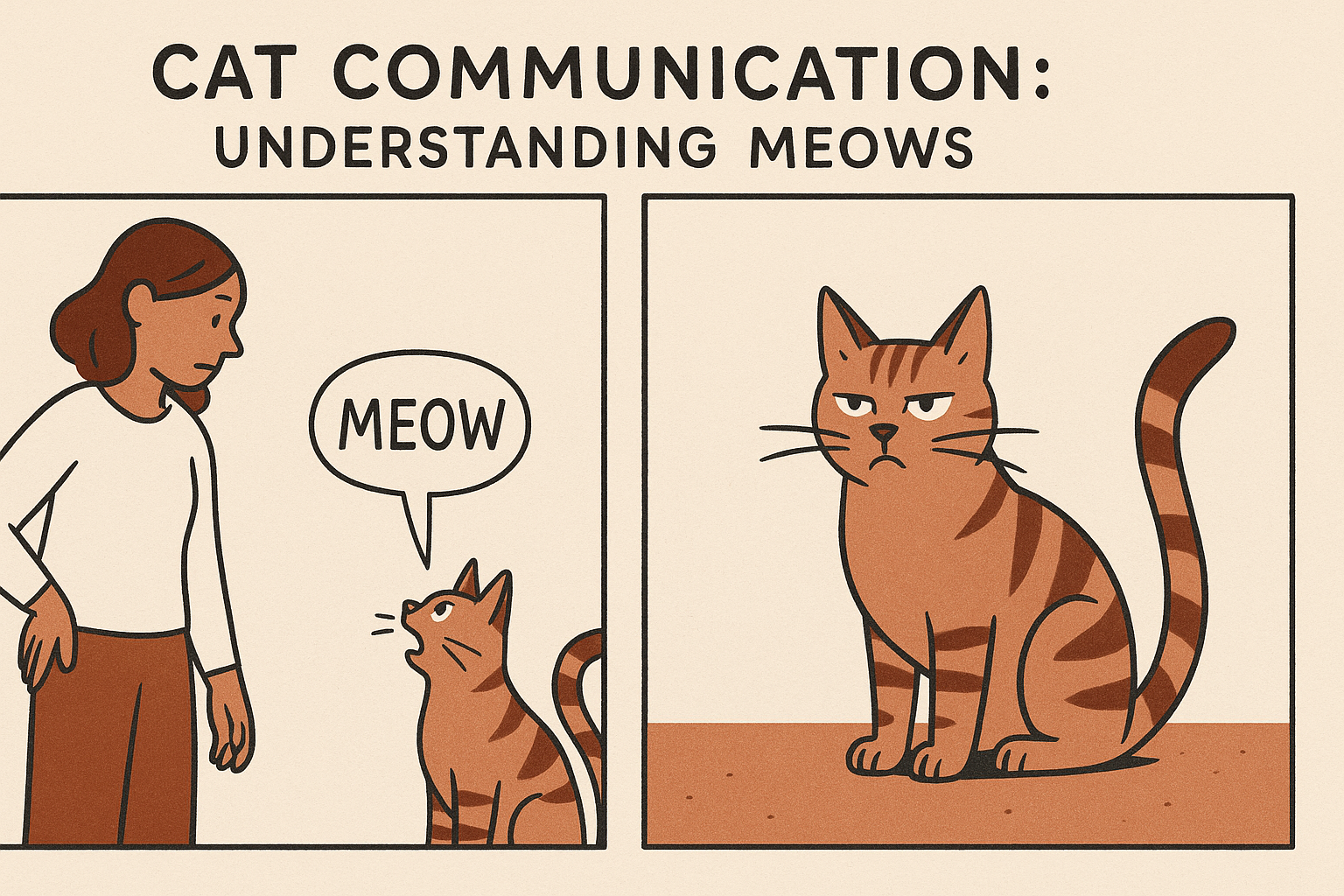
Cats rely on meows as a primary form of communication with humans, a behavior that distinguishes domestic cats from their wild counterparts. Unlike wild felines, domestic cats primarily meow to interact with people, rather than other cats. This unique vocalization appears to be an evolutionary adaptation, honed as cats increasingly cohabited with humans, who are responsive to their vocal cues. Understanding the nuances of cat meows can enhance communication between you and your pet, improving the relationship and addressing their needs more effectively.
TL;DR: Cat meows are primarily used to communicate with humans, with variations in pitch and duration indicating different needs or emotions.
Why Do Cats Meow?
Understanding why cats meow begins with acknowledging that this behavior is largely reserved for human interaction. Research indicates that cats use meows to express various needs, including soliciting attention, requesting food, or signaling distress (Harvard Gazette). The solicitation purr, for instance, resembles a human baby's cry, designed to elicit a nurturing response from humans. This particular sound is a fascinating example of how cats have adapted their vocalizations to influence human behavior.
The context in which a meow occurs significantly influences its interpretation. Meows during isolation are often perceived negatively, reflecting a cat’s distress, whereas meows during activities like brushing are perceived positively (Nicastro and Owren, 2020). By observing the situation in which your cat meows, you can gain insights into what they might be trying to convey. For instance, if your cat meows persistently near the door, it might signal a desire to explore outside, a behavior that could be linked to their natural hunting instincts.
In addition to environmental cues, individual cat personalities can influence meowing behavior. Some breeds, like the Siamese, are known for being more vocal and may meow more frequently or with greater variation in pitch and tone. Understanding these breed-specific tendencies can further aid in interpreting your cat's vocalizations. Moreover, cats that have been socialized with humans from a young age may develop more complex vocal patterns compared to those with limited human interaction.
What Do Different Cat Meows Mean?
Cat meows vary significantly in pitch, duration, and volume, each variation conveying different messages. Research by Schötz and colleagues reveals that these vocal variations are used to express needs such as hunger or distress (Schötz et al., 2019). A long, drawn-out meow could indicate a demand for attention or food, while short, quick meows might be a greeting or acknowledgment of your presence.
Cats are capable of producing a wide array of meows tailored to different contexts. A sharp, high-pitched meow may signal annoyance or discomfort, whereas a low-pitched, drawn-out meow might suggest dissatisfaction or a complaint. By paying close attention to the subtle differences in your cat's vocalizations, you can better interpret their emotional state and meet their needs more effectively. For example, a cat that meows loudly and persistently when its food bowl is empty is clearly communicating hunger, while a softer meow when you return home might express contentment or a simple greeting.
Observing how your cat's meows change with different situations can also be enlightening. If a cat meows more during certain times of the day, such as early morning or late evening, it might be linked to their natural activity cycles or feeding schedules. Cats are crepuscular animals, meaning they are most active during dawn and dusk, which could explain increased vocalizations during these periods. Additionally, changes in the household environment, such as the introduction of a new pet or a change in routine, can also impact the frequency and type of meows your cat uses.
Practical Advice for Responding to Meows
To effectively respond to your cat’s meows, consider the following steps:
-
Observe the Context: Note what is happening when your cat meows. Are they near their food bowl, indicating hunger, or by the door, suggesting they want to go outside?
-
Consider the Pitch and Duration: High-pitched meows might signify excitement or distress, while lower meows could point to contentment or complaint.
-
Respond Appropriately: If a meow signals hunger, ensure your cat has access to their food. If they are meowing for attention, take some time to engage with them through play or petting.
-
Monitor for Patterns: Over time, you may notice patterns in your cat's meows that help you anticipate their needs.
-
Use Positive Reinforcement: Responding to meows with positive reinforcement, like treats or affection, can help strengthen your bond and encourage communication.
Understanding your cat's specific vocal patterns can also prevent miscommunication. If your cat tends to meow excessively, it might be worth investigating potential underlying issues such as illness or environmental stressors. Consulting with a veterinarian can rule out health problems that might be causing distress-related vocalizations. For more insights on managing cat behavior, you might explore cat territorial behavior.
Misinterpreting Cat Meows
While understanding cat meows is crucial, misinterpretation is common. A study by Nicastro and Owren highlighted how humans often perceive meows in isolation as more negative than those during positive interactions like brushing. One common mistake is assuming all meows indicate distress. While this is sometimes the case, meows can also denote contentment or curiosity, depending on the context.
To avoid misinterpretation, combine the auditory cues of meows with other signals such as body language. Observe tail position, ear orientation, and facial expressions to gain a fuller picture of your cat's emotional state. For more detailed insights, you might explore cat body language to enhance your understanding.
Additionally, consider the role of environmental factors in influencing meowing behavior. Changes in household routines, the introduction of new pets, or even alterations in the home environment can affect a cat's vocalizations. Being mindful of these factors can help in distinguishing between a meow that signals genuine distress and one that is simply a reaction to change.
FAQ
Why do adult cats not meow at each other?
Adult cats do not typically meow at each other because meowing has evolved primarily as a way to communicate with humans, who are more responsive to vocal cues.
What does a high-pitched cat meow mean?
A high-pitched meow can indicate excitement or distress. Context is crucial; observe your cat's environment to interpret their needs accurately.
Can cats change their meows over time?
Yes, cats can adjust their meows based on their experiences and the responses they receive from humans. This adaptability helps them communicate more effectively with their caregivers.
How can I tell if a meow indicates distress?
Look for accompanying signs such as tense body language, rapid breathing, or dilated pupils, which can confirm that a meow signifies distress.
Do all cats meow the same way?
No, there is considerable variation in meow types among individual cats. Factors such as breed, personality, and experience with human interaction can lead to different vocal styles.
Understanding cat meows is a nuanced process that requires attention to detail and a willingness to learn from your pet. By observing, listening, and responding thoughtfully, you can enhance your communication with your feline companion, enriching your relationship and ensuring their needs are met.

