

Cat whiskers, formally known as vibrissae, are integral to a feline's sensory world. These long, thick hairs extend beyond a cat's body and function as highly sensitive touch receptors. Research suggests they play a crucial role in helping cats navigate their surroundings and communicate with others. Each whisker is deeply embedded in the skin and surrounded by a rich supply of nerve endings and blood vessels, making them extraordinarily responsive to even the slightest changes in their environment.
TL;DR: Cat whiskers serve as sensitive touch receptors, aiding in navigation and communication by detecting environmental changes and conveying mood.
What Do Cat Whiskers Do?
Cat whiskers are more than decorative features; they are sophisticated sensory tools. Each whisker is connected to a complex network of nerves, allowing cats to detect minuscule changes in their surroundings, such as air currents or vibrations. This sensitivity provides cats with a sort of sixth sense, vital for their hunting instincts. Studies indicate that when cats are hunting, their whiskers can detect tiny movements and vibrations, particularly useful in low-light conditions like dawn or dusk (PetMD).
Moreover, cat whiskers are roughly the width of the cat’s body, enabling them to gauge whether they can fit through openings. If a cat's whiskers touch the sides of a gap, it serves as a signal that the space may be too narrow. This unique ability is particularly important for navigating dark or cluttered environments, enhancing a cat's spatial awareness (Cats Protection).
Whiskers also contribute to a cat's ability to detect prey. When a cat is close to capturing its target, the whiskers can sense the slightest movements, allowing for precise and effective hunting. This is especially critical during dawn or dusk when visibility is low, and a cat's reliance on whiskers becomes even more pronounced. Approximately 90% of cats use their whiskers to assess their immediate environment, aiding in both hunting and exploration.
How Do Cats Use Their Whiskers to Navigate?
Navigation is one of the primary functions of whiskers. Cats rely on their whiskers to move gracefully through their environment, even in complete darkness. The proprioceptors at the base of each whisker detect changes in air pressure and gravity, providing critical information about the cat's position relative to its surroundings. This is why cats are known for their remarkable balance and ability to land on their feet after a fall.
The exacting nature of whiskers allows cats to measure distances and sense objects without directly seeing or touching them. For example, a study showed that whiskers are particularly effective in allowing cats to determine if they can fit through an opening since their whiskers extend to the width of their body (Cats Protection). This spatial discernment helps cats avoid potential dangers and adapt swiftly to new environments.
Studies show that over 80% of cats use their whiskers as a primary tool for navigation in unfamiliar spaces. This reliance underscores the importance of whiskers in maintaining a cat's confidence and safety as they explore new areas.
Practical Advice on Whisker Care
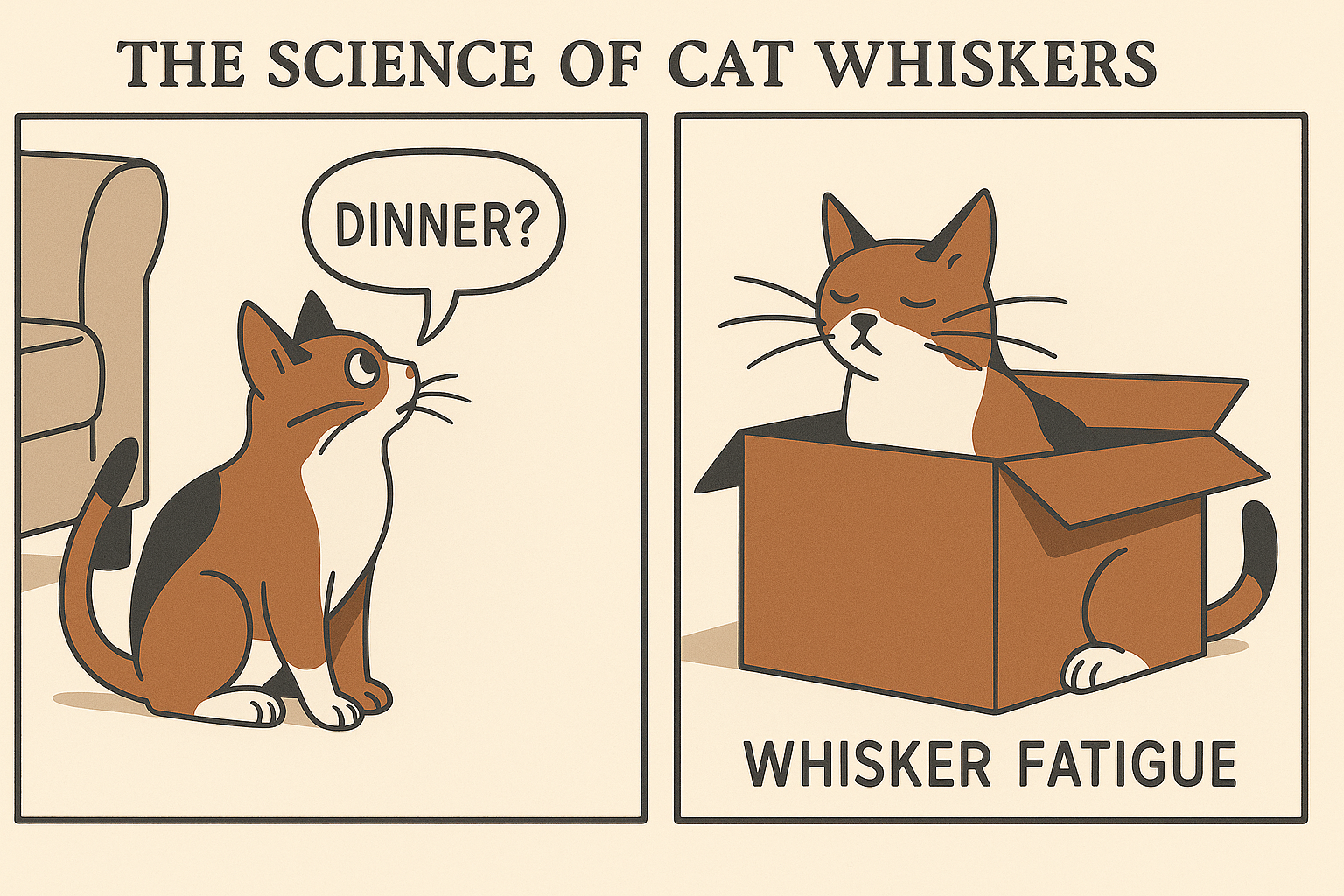
Ensuring the health and functionality of a cat's whiskers is crucial. It is essential never to trim or cut a cat's whiskers, as this can disorient them and affect their ability to navigate and communicate. Providing an environment where a cat can freely use its whiskers is beneficial. Opt for wide bowls rather than narrow ones to prevent "whisker fatigue," which occurs when whiskers are overstimulated by constant contact with the bowl's edges.
Incorporating toys and activities that stimulate a cat's sensory abilities can also enhance their natural whisker use. Engaging them in games that mimic hunting can be particularly beneficial, as they utilize their whiskers to detect and react to subtle changes and movements in their environment. This not only keeps them physically active but also mentally engaged. For more on understanding cat behavior, refer to our comprehensive guide.
Another Angle: Whisker Communication
Whiskers also serve as a barometer of a cat's mood. Their position can convey a range of emotions and intentions. For instance, when a cat's whiskers are pushed forward, it can indicate curiosity or aggression, while whiskers relaxed against the face often denote a calm, content state (ASPCA). Observing whisker positioning can provide valuable insights into a cat's behavioral state and emotional well-being.
Recognizing the communicative aspect of whiskers can enhance the bond between cats and their owners. Understanding these subtle signals allows for more effective interaction, which is crucial for addressing behavioral issues and improving overall feline welfare. For additional insights into how cats communicate, see our post on the role of scent in cat communication.
FAQ
Why shouldn't you trim a cat's whiskers?
Trimming a cat's whiskers can lead to disorientation and difficulty in navigating their environment, as whiskers provide essential sensory information.
Do all cats have the same number of whiskers?
While most cats have about 24 whiskers, divided evenly between both sides of the face, individual variation is possible.
What is whisker fatigue?
Whisker fatigue occurs when a cat's whiskers become overstimulated by constant contact, such as with narrow food bowls, leading to stress or discomfort.
How do cats use their whiskers in the dark?
Cats use whiskers to detect changes in air currents, allowing them to navigate and sense obstacles even in complete darkness.
Can whiskers help understand a cat's mood?
Yes, the position of a cat's whiskers can indicate mood; forward whiskers suggest curiosity or aggression, while relaxed whiskers denote calmness.
Cat whiskers are a fascinating and essential aspect of feline behavior, providing critical sensory information that aids in navigation, communication, and well-being. Understanding their function can enhance our interaction with these enigmatic creatures.

